


-32x32h.jpg)


-32x32h.jpg)

-32x32h.jpg)


-1000x1000h-32x32.jpg)


-32x32.png)


-32x32w.jpg)



-1000x1000w-150x150.jpg "DT Adventure Portable Camping 55L Compressor Car Fridge Freezer")
-1000x1000w-150x150.jpg "DT Adventure Portable Camping 55L Compressor Car Fridge Freezer")



Published 26 September 2026 · OFM4x4.CO.UK
Choosing a 4x4 lift kit is not just a question of how many millimetres of lift you want. The spring must suit the weight your vehicle carries most of the time. Fit a spring intended for a permanently loaded vehicle to an almost-empty daily driver and the ride may be unnecessarily firm. Choose too little support for a vehicle with a winch, steel bumpers or drawers, and the extra weight can reduce the lift you expected.
This guide explains what suspension load ratings mean, how to assess front and rear loads separately, and what to check before ordering. It is a buying guide, not a substitute for the spring manufacturer's application chart for your exact vehicle.
Choose front and rear springs for the weight your vehicle carries most of the time. Confirm the exact vehicle application, fitted accessories and plated weight limits; treat the desired lift height as a separate choice.
In this guide
- Understanding spring load ratings
- Permanent versus occasional loads
- Front and rear axle loads
- Load rating versus lift height
- Five checks before ordering
- Common questions
- Get help choosing a kit
What does a spring load rating actually mean?
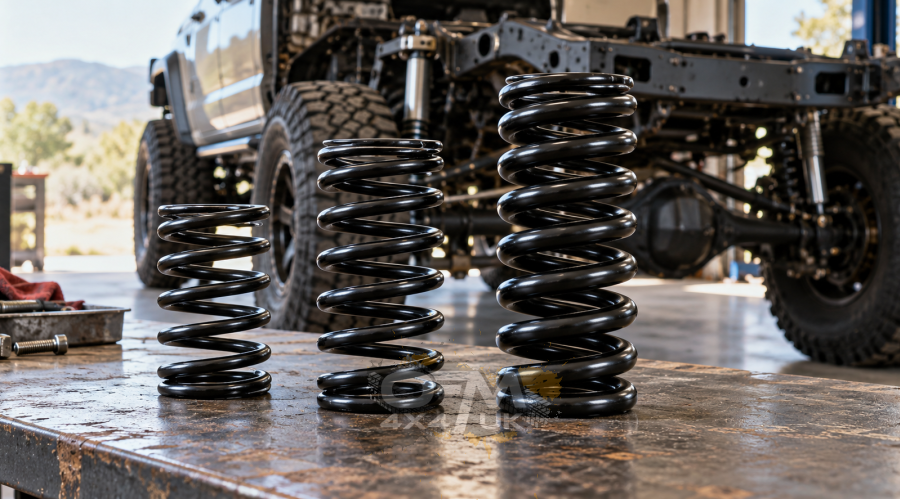
Terms such as standard load, medium load, heavy load and constant load describe the intended vehicle configuration. A quoted range such as “0–50 kg” or “300 kg constant load” is not a universal rule that applies to every 4x4 or every brand. Check the specific manufacturer's notes: the figure may refer to additional equipment carried at one end of a particular vehicle, and the correct spring can change with engine, body style and accessories.
Most importantly, a load-rated spring is not permission to exceed the vehicle's plated gross weight or axle limits. It is a way to match suspension support to the weight you actually carry within those limits.
Permanent weight versus occasional cargo
| How the vehicle is used | Typical examples | Spring-selection implication |
|---|---|---|
| Mostly unladen | Daily driving with occasional luggage | Do not automatically select the heaviest available spring just for more lift. |
| Constant added weight | Fixed winch and steel front bumper; permanent drawers or rear bumper | Choose a spring option intended to support that fitted weight at the relevant axle. |
| Occasional heavy trips | Camping gear, tools or a trailer on some weekends | Discuss the loaded and unloaded use with the supplier; a permanent heavy-load spring may be a poor everyday compromise. |
Manufacturers make this distinction for a reason. Ironman 4x4 describes its heavy-load option as suitable for vehicles carrying the specified extra weight at all times. Old Man Emu also offers application-specific springs for sustained additional loads. The labels are a starting point; the individual product's fitment notes are the authority.
Assess the front and rear separately
Write down everything fitted to the vehicle before choosing a spring. At the front, count items such as a steel bumper, winch, auxiliary battery and other fixed equipment. At the rear, consider drawers, a rear bumper, spare-wheel carrier and equipment that normally stays in the vehicle. A roof rack or tent also contributes to the vehicle's total weight, but its effect on each axle depends on where it sits and on the vehicle layout; do not simply assign all of it to the rear.
For a heavily equipped build, the most defensible approach is to weigh the vehicle by axle in its normal travelling configuration. Compare the results with the vehicle's plated limits and the spring manufacturer's application guide. If accessories are still planned, tell us what will actually be installed—selecting springs solely for an imagined future build can leave today's vehicle riding poorly.
Spring rating and lift height are different decisions
A “50 mm lift” is usually a nominal target, not a guaranteed measured result on every vehicle. Existing spring sag, engine and accessory weight, fuel level and the particular spring option all affect the final height. A heavier spring may sit higher on an unladen vehicle, but that does not make it the right way to gain lift. It can reduce comfort and may leave the suspension outside the intended operating range.
Springs support the vehicle's static weight; shock absorbers control suspension movement. A complete kit should be selected as a matched application, including any vehicle-specific installation and geometry requirements. For a broader comparison of kit types, see our 4x4 suspension lift-kit guide.
Five checks before you order
- Confirm the exact vehicle: model, generation, production year, engine, body style and relevant factory suspension systems.
- List permanent accessories: especially front and rear steelwork, winch, drawers and spare-wheel carrier.
- Separate constant from occasional load: the best touring setup may not be the best daily-driver setup.
- Check plated weight limits: suspension upgrades do not automatically increase legal gross or axle ratings.
- Match the whole kit: check the spring, damper and any required correction or fitting parts against the manufacturer's vehicle-specific guidance.
Common questions
Will a heavy-duty spring give me a better lift?
It may change the measured ride height, especially when the vehicle is empty, but that alone is not a reason to choose it. The spring must suit the weight carried and the intended ride.
Does a 300 kg spring mean I can add 300 kg to my payload?
No. A spring's application or constant-load figure is not a vehicle payload re-rating. The vehicle's plated limits still apply.
Can I choose the same load rating at both ends?
Not by default. Front and rear axle loads, suspension designs and accessory locations differ. Select each end according to the exact vehicle and its equipment.
Need help matching a kit?
Send OFM4x4.co.uk your vehicle details and a list of accessories already fitted or firmly planned. We can then check the manufacturer's options rather than guessing from lift height alone. The related products below show different suspension approaches for specific vehicles; always confirm fitment and the appropriate load option before ordering.
Technical references: Ironman 4x4 lift-kit selection and Old Man Emu heavy-duty rear spring application. Manufacturer specifications and fitment notes take precedence over general guidance.
Related Products




Leave a comment