


-32x32h.jpg)


-32x32h.jpg)

-32x32h.jpg)


-1000x1000h-32x32.jpg)


-32x32.png)


-32x32w.jpg)




-1000x1000w-150x150.jpg "DT Adventure Portable Camping 55L Compressor Car Fridge Freezer")
-1000x1000w-150x150.jpg "DT Adventure Portable Camping 55L Compressor Car Fridge Freezer")



Updated 25 September 2026 · OFM4x4.CO.UK
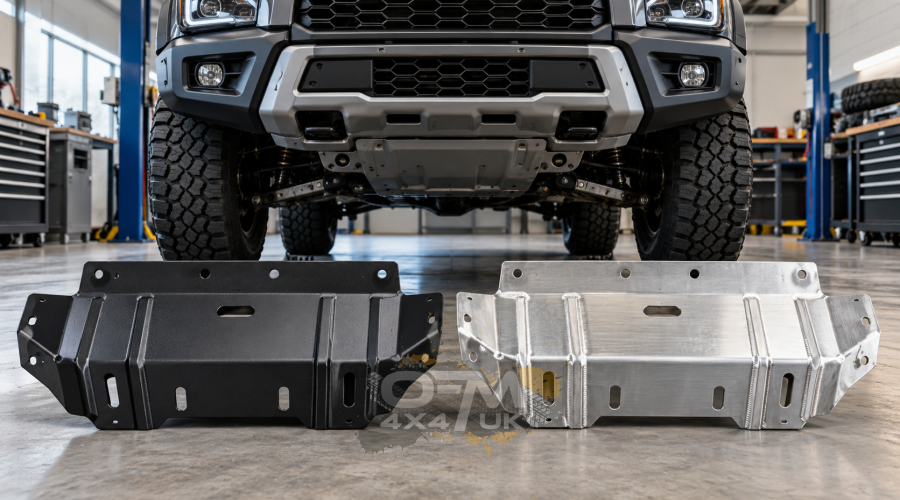
Choosing between steel and aluminium underbody protection starts with your vehicle, the terrain you drive and how much weight you already carry. Both materials can make effective sump guards and skid plates. Neither is automatically the right answer for every 4x4.
Consider steel when purchase cost is a priority, and the complete kit weight suits your build. Consider aluminium when reducing added weight matters. In both cases, compare the actual guard: its thickness, reinforcement, mounting system, coverage and confirmed fitment matter more than the material name alone.
In this guide
- Steel vs aluminium at a glance
- Why thickness is only part of the story
- Choosing for your driving
- Four product examples
- Fitment, lifts and diff drops
- Servicing and maintenance
- Common questions
Steel vs aluminium underbody protection at a glance
| Buying consideration | Steel | Aluminium |
|---|---|---|
| Weight | Often the heavier option. Check the supplied kit weight. | Often lighter, even with thicker plates. Brackets and coverage affect the saving. |
| Price | Frequently a lower purchase price for a comparable application. | Frequently costs more. Decide whether the weight saving justifies it. |
| Impact protection | Depends on grade, shape, reinforcement and mountings. Can bend or suffer damage. | Also depends on alloy, construction and mountings. Thickness alone is not a strength rating. |
| Corrosion care | Inspect damaged coatings and treat exposed steel as instructed. | Does not develop red iron rust, but still needs cleaning and corrosion checks, including steel brackets and fasteners. |
| Service access | Check the individual design for drain-plug access and removal requirements. | Check the same details; a lighter plate is not automatically easier to service around. |
Why thickness is only part of the story
A 4mm aluminium guard and a 3mm steel guard are not directly comparable simply by looking at those numbers. Plate material, unsupported spans, folds, reinforcement and the way loads reach the mounting points all influence how the assembly behaves.
A thick plate attached through weak or unsuitable mountings is not a well-protected vehicle. Look for a design intended for your exact application, with the correct brackets and fitting instructions. Without comparable impact testing, we would not claim that one specific kit is stronger solely because it is steel or thicker aluminium.
Also compare coverage. An engine sump guard does not necessarily protect the gearbox, transfer case or fuel tank. A “complete” kit may still exclude some of those areas; read its component list.
Which should you choose for your driving?
Daily driving and occasional green laning
Start with the exposed components and the tracks you actually use. A suitable steel guard can be a sensible purchase where budget matters. Aluminium may be preferable if you want to limit added weight. Avoid paying for a kit that does not fit your engine, transmission or bumper arrangement.
Touring and overlanding
A vehicle carrying a winch, bumpers, drawers, water and camping equipment benefits from careful weight planning. Compare the weight of the whole protection package, including brackets. Aluminium is worth considering here, but a guard should still provide the coverage and mounting design your intended terrain requires.
Regular rocky terrain
Choose by the manufacturer's stated application and construction details. Do not assume every steel guard is suitable for repeated hard impacts, or that aluminium is only for light use. Both can be damaged. After a significant strike, inspect the guard, brackets and clearance before continuing.
Four product examples from our range
These examples show two material choices for two different Land Cruiser applications. They are alternatives within each vehicle group, not four parts to fit to the same vehicle.
Toyota Land Cruiser 250, 2024 onwards: complete kits
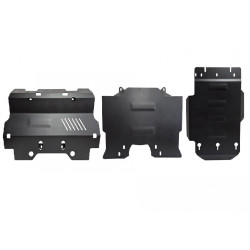
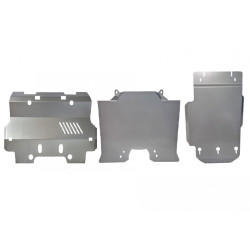
- 3mm steel complete underbody protection kit — a three-piece package listed at approximately 30kg.
- 4mm aluminium complete underbody protection kit — a three-piece package listed at approximately 21kg.
That is an approximate 9kg difference between these listed packages. It is a useful weight comparison, not evidence of equal impact performance. Check each product's coverage and your vehicle specification before ordering.
Toyota Land Cruiser Prado 120 / J120, 2002–2009: front guards
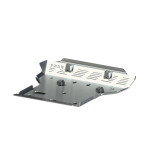
- Steel engine and sump guard — a vehicle-specific option for front underbody protection.
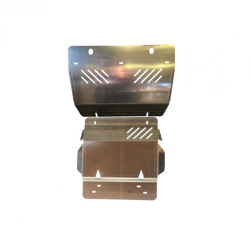
- 4mm aluminium engine and sump guard — aluminium plate with steel mounting brackets. The listing specifies no oil sump service opening.
These front guards are not complete underbody kits. If adding gearbox protection, check which matching front guard it requires. Mixing different manufacturers or steel and aluminium sections is only appropriate when their mounting arrangements are confirmed compatible.
Check fitment before choosing the material
Send us the following details if you are unsure:
- Model, year and chassis/model code.
- Engine and manual or automatic transmission.
- Wheelbase or body style where applicable.
- Original or aftermarket front bumper.
- Suspension lift, diff-drop kit and any other underbody modifications.
- Existing protection plates you want to retain.
A lift does not prove that a guard will fit. A diff drop changes the position of components relative to the guard and can reduce clearance. A related chassis also does not confirm compatibility: a Prado 120 listing should not be treated as approval for a Hilux Surf, 4Runner or FJ Cruiser without checking the specific application.
Follow the guard manufacturer's fitting instructions. Clearances around the drivetrain, exhaust and moving components must be checked. Do not improvise spacers or mounting changes to force a mismatched guard to fit.
Servicing and maintenance: both materials need attention
Check whether oil servicing requires removing a plate, how easily trapped mud can be cleared and whether the supplied fasteners remain accessible. A service opening is a product feature, not a property of steel or aluminium.
After muddy use, clean out accumulated debris and inspect coatings, fasteners and mounting points. Check for deformation or contact with the components behind the guard. Use the manufacturer's tightening and inspection guidance. Aluminium is not maintenance-free, and steel is not immune to denting.
Underbody armour helps reduce the risk of direct impact damage. It does not replace careful line choice, vehicle maintenance or corrosion treatment, and it cannot guarantee protection from every strike.
Common questions
Is aluminium underbody protection strong enough for off-road use?
It can be, when the specific guard is designed for the vehicle and intended use. Assess the whole assembly and the manufacturer's guidance rather than dismissing aluminium on material alone.
Is steel always the better value?
Not necessarily. Compare the complete fitted package, included brackets, coverage, servicing access and weight. The cheapest individual plate may not be the most suitable system for your build.
Can I combine steel and aluminium guards?
Sometimes, but adjoining sections may share mountings or depend on one another. Confirm the exact combination before buying.
Will a sump guard fit with my diff-drop kit?
Do not assume it will. Tell us which diff-drop kit is fitted and provide photographs where possible so the available clearance and guard application can be checked.
Find protection that suits your 4x4
Browse steel and aluminium underbody protection, then compare the options for your exact vehicle. If fitment is uncertain, use the product page's enquiry option and include your vehicle details and modifications before ordering.
Related Products

Leave a comment