









Published 2 October 2026 · OFM4x4.CO.UK
12V Camping Fridge Battery Runtime: How to Calculate Your Power Needs
Will your camping fridge stay cold from Friday evening until Sunday afternoon? A battery’s headline capacity cannot answer that on its own. You need the fridge’s energy use, the battery energy you can actually use and a realistic plan for recharging.
This guide gives you a repeatable calculation for a 4x4 camping setup, with worked examples you can replace with your own readings. The example figures are illustrative, not measured performance claims for any fridge or battery sold by OFM4x4.
The quick answer
Estimated runtime in hours = usable energy in watt-hours ÷ average power in watts. Use consumption measured over a representative day, include other equipment and leave a reserve. A compressor’s running wattage is not necessarily its average consumption over 24 hours.
In this guide
Measure consumption over a full day
Watts (W) describe power at a moment in time; watt-hours (Wh) describe energy used over time. A steady 20W load uses 480Wh in 24 hours. Compressor fridges cycle, so a brief reading while the compressor runs can give a misleading daily estimate. EcoFlow’s power-sizing guidance explains this distinction and the need to consider both energy capacity and output power.
Use a suitable energy meter or battery monitor to record a complete day. Note the fridge temperature setting, surrounding temperature, contents, lid openings and whether the test includes cooling a warm fridge. Measure at the battery output if you want wiring and conversion losses included. Keep that measurement point consistent when comparing results.
Record the setup as a short trip log: “24 hours, fridge mode, loaded before departure, usual lid openings, 360Wh.” That tells you much more than “it draws 45W”. Repeat the test in conditions that resemble your intended trip; one cool driveway test does not establish summer performance.
Work out usable battery energy
For a nominal energy comparison, multiply amp-hours by nominal voltage: 100Ah × 12.8V = 1,280Wh. That is not permission to use every watt-hour. Starting charge, permitted depth of discharge, battery condition, temperature and system losses affect the energy available before your chosen reserve.
Check the battery manufacturer’s limits rather than applying one universal percentage to AGM and lithium batteries. Victron’s capacity guidance also explains why discharge rate affects capacity, particularly for lead-acid batteries. Its lithium battery operating guidance shows that temperature and depth of discharge matter too; use the instructions for your specific battery.
For a portable power station, ask about usable energy at the output you intend to use. Also check that the DC socket supports the fridge’s voltage and current requirements. Keep vehicle starting needs separate from the camping energy budget.
Calculate your weekend runtime
Suppose your measured daily budget is 360Wh for the fridge, 40Wh for lights and 60Wh for charging small devices. The total is 460Wh per day, or about 19.2W averaged over 24 hours. A 48-hour stay needs 920Wh at the same measurement point, before any additional contingency.
If 800Wh is available after your chosen reserve and relevant losses, estimated runtime is 800 ÷ 460 × 24 = about 42 hours. It does not cover that 48-hour plan without reducing demand or adding a verified recharge.
| Illustrative total consumption | 500Wh usable | 800Wh usable |
|---|---|---|
| 240Wh per day | 50 hours | 80 hours |
| 360Wh per day | 33 hours | 53 hours |
| 600Wh per day | 20 hours | 32 hours |
These rounded calculations assume constant daily demand, no recharge and usable energy already allowing for losses and reserve. They are planning examples, not guaranteed runtimes. Include every load sharing the supply.
Plan recharging and solar
Write down when energy can actually return: a campsite hookup, an approved vehicle charging system or solar during a suitable stop. Count energy delivered to the battery, rather than a charger’s maximum rating multiplied by the whole time you are away.
A panel’s 100W rating is not a promise of 100W throughout daylight. For illustration, an average measured 50W reaching the battery for four hours adds 200Wh. Against the 460Wh daily budget above, that still leaves a 260Wh deficit. Shade, weather, positioning and system losses make a dependable backup worthwhile.
Leave the fridge’s ventilation clear of luggage and follow its installation instructions. Dometic’s refrigeration troubleshooting advice highlights heat rejection and voltage drop as practical concerns. If the fridge cuts out early, check the supply and connections under load before assuming that a larger battery is the answer. Have fixed wiring, fuse protection and cable sizing checked by a competent installer.
Choose compatible fridge and solar equipment
These OFM4x4 listings offer starting points for a system discussion. They are separate components, not a pre-verified complete kit.
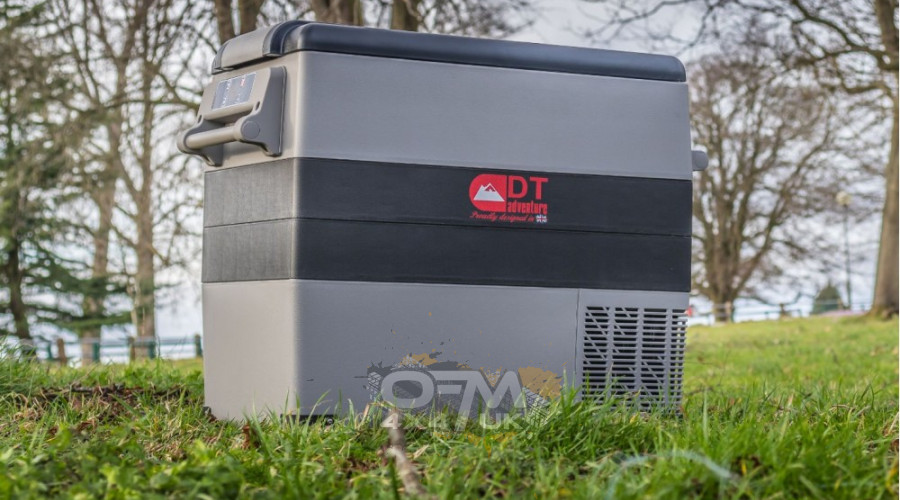
- DT Adventure Portable 55L Compressor Car Fridge Freezer: listed with 12V, 24V and 230V power options and three-level low-voltage protection. Obtain representative energy-consumption information or measure your setup before sizing a battery.
- 20A MPPT Solar Charge Controller, Win500-KT: listed for 12V/24V systems with selectable battery types. Confirm the correct charging profile and all panel input limits against your battery and panel specifications.
- Lensun 100W 12V ETFE Flexible Solar Panel: a nominal 100W panel option. Check mounting requirements, controller compatibility and expected seasonal yield before relying on it for a weekend’s recharge.
For size and layout choices, see our portable fridge buying guide. Use the measured energy calculation here for your own runtime plan.
Common questions
How long will a 100Ah battery run my fridge?
There is no single reliable answer. Identify nominal voltage, usable capacity, starting charge and measured daily consumption first, then calculate runtime with your other loads included.
Does low-voltage protection guarantee the vehicle will start?
Do not treat it as a starting guarantee. Choose the protection setting using the fridge and battery instructions, and use an appropriate camping power arrangement that preserves starting capacity.
Can I budget only for the fridge?
Only if it is genuinely the sole load. Write down lights, chargers and any equipment left connected. Small continuous loads can make a meaningful difference over two nights.
Need help planning your camping setup?
Contact OFM4x4 with your fridge model, battery specification, measured Wh per day, trip length and proposed charging equipment. Those details let us discuss a useful combination rather than guess from battery size alone.
Related Products


Leave a comment