


-32x32h.jpg)


-32x32h.jpg)

-32x32h.jpg)


-1000x1000h-32x32.jpg)


-32x32.png)


-32x32w.jpg)




-1000x1000w-150x150.jpg "DT Adventure Portable Camping 55L Compressor Car Fridge Freezer")
-1000x1000w-150x150.jpg "DT Adventure Portable Camping 55L Compressor Car Fridge Freezer")


Published 8 October 2026 · OFM4x4.CO.UK
A panel that fits the bonnet still needs to match the electrical system. Its wattage describes rated power; it does not tell you whether a charge controller or portable power station can accept it.
Before choosing adapters or routing cable, compare the panel data sheet with the exact charging input. These checks apply whether you are topping up a leisure battery or connecting a panel to an integrated power station.
The quick answer
Check maximum panel open-circuit voltage in the coldest expected conditions, current limits, connector polarity and the charger’s supported battery settings. Match the panel to the exact solar input. A physically compatible plug or a “12V” label does not establish electrical compatibility.
In this guide
Start with the electrical ratings
Record the panel’s open-circuit voltage (Voc), voltage at maximum power (Vmp), short-circuit current (Isc) and current at maximum power (Imp). Then find the charging device’s maximum solar voltage, current limits and operating voltage range in its manual.
| Item | Why it matters |
|---|---|
| Voc | Must remain within the charger’s maximum input voltage, including cold-weather allowance |
| Vmp | Must suit the input’s operating range |
| Isc and Imp | Compare with the input limits using the maker’s sizing procedure |
| Watts | Check permitted array sizing after voltage and current |
Allow for cold-weather voltage
Panel open-circuit voltage increases as cell temperature falls. A combination that appears acceptable at the data-sheet reference temperature can exceed an input limit on a cold morning. Use the panel’s temperature coefficient and the controller maker’s sizing method or calculator.
Victron’s BlueSolar MPPT guidance explains the importance of staying below the controller’s rated maximum PV voltage. Its limits belong to those controllers; use the manual for your own unit rather than copying a limit from another model.
Confirm how the battery is charged
A bare solar panel should not be connected straight to a battery unless the equipment manufacturer explicitly provides for that arrangement. A suitable charging controller manages the charge profile. Confirm battery chemistry, nominal system voltage and the battery maker’s charging requirements.
For lithium batteries, include temperature restrictions and any BMS requirements in the check. An integrated power station normally has its own solar charging electronics: follow its input instructions rather than assuming a second external controller is needed.
Verify connectors, polarity and protection
Matching connector shapes can conceal different polarity or pin arrangements. Check the equipment documentation and have a competent installer verify polarity before connection. Choose cable, protection and connectors for the actual current, route and installation environment.
Do not improvise a lead from an accessory socket simply because it is conveniently positioned. Decide where the charge controller, isolating arrangements and battery connection belong before mounting the panel. Follow the specified connection sequence.
Treat bonnet fit and electrical fit separately
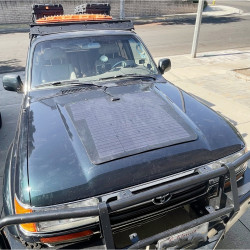
OFM4x4 lists 100W Land Cruiser 80, 100W Land Cruiser 100 and 125W Patrol Y61 bonnet panels. These are vehicle-specific alternatives, not interchangeable fitments.
Check the exact panel specification and whether the selected order includes a controller. Before bonding anything to paintwork, confirm the installation procedure, bonnet condition, cable exit and clearance through the full bonnet movement.
Common solar compatibility questions
Can I add a second panel later?
Recalculate the complete array first. Series connections raise voltage; parallel connections raise current. The original single-panel check does not cover the expanded system.
Will rated watts arrive at the battery?
Not continuously. Temperature, sunlight, shading, panel orientation and charging losses change actual output. Compatibility and daily energy yield are separate questions.
What information should I send before ordering?
Send the vehicle variant, panel part number, controller or power-station model, battery details and proposed cable route. Photographs of electrical labels are more useful than a general “12V system” description.
Check the complete solar combination
Contact OFM4x4 with the panel and charging-device details before ordering. We can help identify the specifications that need to match.
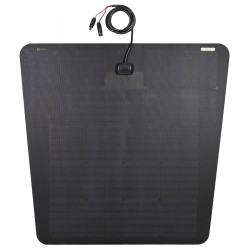
Main image: genuine bonnet solar-panel catalogue photograph. Vehicle fitment does not demonstrate compatibility with every charger or power station.
Related Products




Leave a comment