


-32x32h.jpg)


-32x32h.jpg)

-32x32h.jpg)


-1000x1000h-32x32.jpg)


-32x32.png)


-32x32w.jpg)



-1000x1000w-150x150.jpg "DT Adventure Portable Camping 55L Compressor Car Fridge Freezer")
-1000x1000w-150x150.jpg "DT Adventure Portable Camping 55L Compressor Car Fridge Freezer")

-150x150h.jpg "Fabryka 4x4 Front Winch Bumper with Bullbar Toyota Land Cruiser HZJ 71 99-07")
-150x150h.jpg "Fabryka 4x4 Front Winch Bumper with Bullbar Toyota Land Cruiser HZJ 71 99-07")


Published 5 October 2026 · OFM4x4.CO.UK
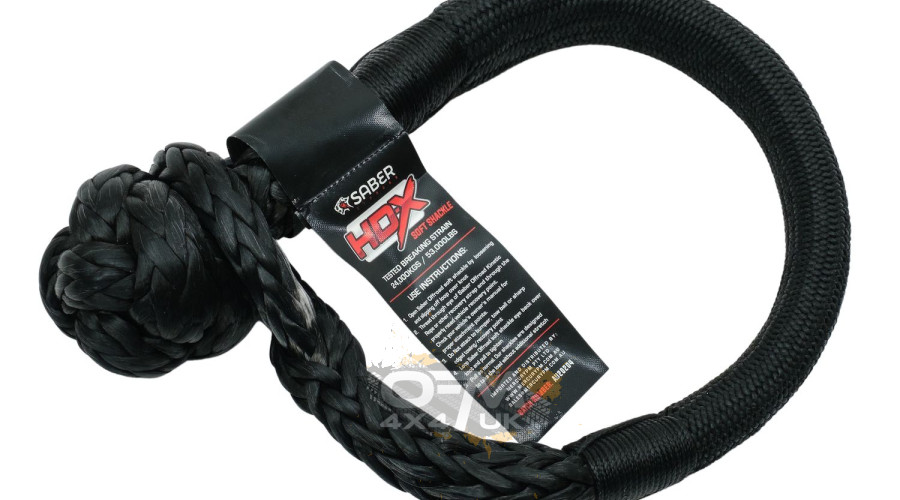
Main image: genuine Saber 24K HDX soft-shackle catalogue photograph. A soft shackle must be used with a compatible, suitably rated attachment.
A tow ball, shipping tie-down eye and rated recovery point can all look like strong metal fixed to a 4x4. They do different jobs. In a kinetic recovery, the rope or strap stores energy, and a failed attachment can travel towards people or vehicles.
Before buying a rope or attempting a pull, identify a recovery attachment approved for the exact vehicle and recovery method. Then check every component between the two vehicles, including mountings and connectors.
The quick answer
Never attach a snatch strap or kinetic rope to a standard tow ball or transport tie-down. Use a suitably rated recovery point or device, installed and used to its maker’s instructions. A 50mm receiver recovery hitch can be an option only if the hitch, receiver, pin and vehicle installation are all approved for that recovery. If the rating or fitment is unknown, stop and verify it first.
In this guide
Tow point, tie-down and recovery point
A towing eye may be intended for a controlled roadside tow. A transport tie-down may only hold a vehicle on a trailer. Neither label proves it can take a dynamic off-road recovery load or an angled pull. ARB explains that generic tow points can have untested mounting locations and limitations under angled recovery loads; its dedicated points are vehicle specific.
Read the vehicle handbook and the recovery-point maker’s instructions. Check the model, year, chassis, bumper or towbar arrangement, mounting hardware and permitted pull direction. A rated accessory bolted to an unsuitable structure does not make the whole installation rated. Paint colour, thickness and a large stamped number alone are not proof of compatibility.
| Attachment | What to verify | Recovery decision |
|---|---|---|
| Standard tow ball | Its towing purpose does not certify kinetic recovery | Do not attach a snatch strap or kinetic rope |
| Transport tie-down | Purpose and mounting in vehicle handbook | Do not assume recovery use |
| Dedicated recovery point or hitch | Vehicle fitment, installation, rating and allowed pull | Use only within the complete system’s instructions |
Why a tow ball is unsafe
ARB’s recovery guidance explicitly warns that a standard tow ball or vehicle tie-down is not designed as a snatch-strap attachment. A detached ball or vehicle part can become a dangerous projectile. A tow rating applies to the specified towing arrangement; it must not be treated as a kinetic-recovery rating.
Removing the ball does not automatically make the exposed tongue a recovery point. Equally, a towbar receiver is not approved merely because an aftermarket recovery hitch slides into it. Confirm the receiver and its vehicle mounting, the correct retained pin, the recovery device and the connector are suitable together. Do not loop a rope over a ball or improvise a connection to a bare pin.
Check the complete recovery path
Work from the stuck vehicle to the recovery vehicle: attachment, shackle, rope or strap, shackle and attachment. The weakest or least certain part limits the setup. Compare like with like: minimum breaking strength describes failure strength, while working load limit describes an allowed working load. Do not treat the two numbers as interchangeable.
Match the recovery gear to both vehicles and the manufacturer’s instructions. ARB advises choosing a snatch strap with minimum breaking strength around two to three times the lighter vehicle’s gross vehicle mass; a needlessly heavy strap may stretch less and load the vehicle’s points more. This is ARB’s guidance for its strap selection, not a universal formula for every kinetic rope. Inspect rope, connectors and points before use, protect against sharp edges, agree on signals and clear bystanders from the line of pull. Use trained help if the recovery is difficult.
Using a receiver recovery hitch
A purpose-made recovery hitch can provide a connection on a compatible receiver. For example, OFM4x4 lists Saber’s cast-steel recovery hitch with 17K sheathed soft shackle and a version with 24K HDX soft shackle. Those are product options, not a declaration that every towbar receiver can take their loads. Check receiver dimensions, pin, manufacturer instructions and vehicle installation before choosing either.
A soft shackle also needs a smooth, suitable contact surface. Inspect the hitch and shackle for burrs, deformation, cuts and abrasion. The shackle’s breaking-strength figure must not be confused with the rated capacity of the receiver or vehicle.
When a recovery bridle helps
Where a vehicle has two suitable rated points and the point maker permits a shared pull, a correctly sized bridle can distribute force between them. OFM4x4’s recovery bridle range is offered in 10mm, 12mm and 14mm options for different setups. A bridle cannot make unrated factory eyes safe, and it does not excuse an excessive angle or poor routing. Follow both the point and bridle instructions, including connector and clearance requirements.
If you are assembling a kit, Saber’s 12K kinetic recovery kit includes a rope and soft shackles; it does not replace the need to verify recovery points on both vehicles. Choose the system as a whole before setting off, rather than discovering at the trailhead that the rope has nowhere approved to connect.
Common questions
Can I snatch a vehicle from its factory towing eye?
Only if the vehicle manufacturer expressly approves that eye for the specific recovery. A towing or tie-down function on its own is insufficient. If the instructions are unclear, do not use it for a kinetic pull.
Does a 3.5-tonne towbar rating mean a 3.5-tonne recovery rating?
No. It describes a specified towing use. Recovery loads and directions differ, and the receiver, pin, hitch and vehicle mountings all need their own suitability check.
Is the strongest rope always safest?
No. Component ratings must be appropriate and compatible. ARB warns that an excessively strong snatch strap on a lighter vehicle may not stretch as intended and can increase stress on recovery points.
Need help checking your setup?
Contact OFM4x4 with the vehicle make, model, year, towbar or bumper details and the recovery equipment you plan to use. We can help identify products and the fitment information that still needs confirmation before ordering.
Related Products


Leave a comment