


-32x32h.jpg)


-32x32h.jpg)

-32x32h.jpg)


-1000x1000h-32x32.jpg)


-32x32.png)


-32x32w.jpg)





-1000x1000w-150x150.jpg "DT Adventure Portable Camping 55L Compressor Car Fridge Freezer")
-1000x1000w-150x150.jpg "DT Adventure Portable Camping 55L Compressor Car Fridge Freezer")



Published 30 September 2026 · OFM4x4.CO.UK
Synthetic Winch Rope Inspection: When to Replace It and What to Buy
A synthetic winch rope can look tidy on the drum while damage is hidden further along its length. Before the next green-laning trip or off-road recovery, make time to inspect the line, its end fittings and the surfaces it runs over. Finding a problem at home gives you time to choose the correct replacement and put the installation right.
This guide covers condition checks and replacement buying decisions. It is for synthetic winch line, not a kinetic recovery rope, and does not replace your winch manufacturer's operating instructions or practical recovery training.
The quick answer
Replace damaged winch rope before use, and investigate what caused the damage. Cuts, serious abrasion, heat damage and persistent distortion need attention. A new line must suit the winch, drum, termination and fairlead; matching its diameter to the old rope is only one part of the check.
In this guide
Inspect the whole rope and its fittings
Follow the winch manual to secure the vehicle and isolate the equipment for hands-on inspection. Wear the specified gloves, keep hands clear of the fairlead and never handle a tensioned line. WARN calls for checks before and after winching, including the rope, heat sleeve and associated components.
Work along the full accessible length in good light. Check the eye, thimble, hook and protective sleeves as well as the main braid. Record where a defect occurs: repeated damage at one point can help an installer identify a contact or routing problem. Do not test a suspect line by pulling harder on it.
Wear signs that need attention
Use the retirement criteria for your exact rope. Samson's visual inspection guide distinguishes compression from damage and covers several rope constructions; its different repair rules should not be treated as interchangeable.
| What you notice | What to do next |
|---|---|
| Cut strands, marked thinning or worsening abrasion | Stop using the line. Compare with its manufacturer's rejection criteria and replace damaged rope. |
| Hard, fused or melted fibres | Treat as heat damage; cleaning will not restore the material. |
| A flattened, shiny area | Compression can relax when flexed. A persistent lump, flat spot or stiff glazed area needs assessment; appearance alone does not establish safety. |
| Unexpected local discolouration or an unknown spill | Identify the contamination and seek the rope maker's advice before reuse. |
WARN explains that a light surface fuzz can develop during initial use, but progressive roughness indicates abrasion. Check internal fibres as instructed as well as the outside. If condition remains doubtful, retire the rope. Do not turn an inspection photograph into a promise of remaining strength.
Cleaning after mud and salt
Start with the instructions supplied for the rope. WARN specifies low-pressure water and no chemicals for its synthetic line. Samson's rope-cleaning guidance permits mild soap or liquid detergent in room-temperature water for its products. That difference matters: a cleaner suitable for one rope is not automatically approved for another.
For a rope whose maker permits washing, gently work dirt out of the braid, rinse thoroughly and avoid forceful scrubbing. Samson recommends drying with airflow at ambient temperature, away from direct sunlight. Keep the line away from artificial heat and follow its storage instructions. Inspect again after cleaning, when mud is no longer hiding the fibres.
Washing is maintenance, not a repair. Do not return a cut, melted or otherwise damaged line to service just because it now looks cleaner.
Choose the correct replacement
Before ordering, send the winch make, model and rated pull, plus the current rope specification and photographs of the drum attachment and fairlead. Ask the supplier to confirm the complete application rather than choosing from a vehicle badge alone.
- Diameter and length: check the winch manufacturer's permitted combination and drum capacity. A longer or thicker rope is not automatically an upgrade.
- Load specification: breaking strength and working load limit are different figures. Use the required rating for the application; do not treat a quoted breaking load as a safe working load.
- Drum connection: confirm the specified attachment and any heat-protection requirements. Different winches can use different terminations.
- Fairlead and hardware: confirm compatibility with synthetic line and inspect contact surfaces for damage before installing the replacement.
- Installation: follow the exact winding direction, tensioning procedure and minimum-wrap requirement in the winch instructions.
Samson's rope selection and handling guidance explains the distinction between strength and working load, and why drum attachments rely on friction wraps. These principles do not establish a universal replacement size or installation procedure for every recovery winch.
Rope and fairlead options
These current OFM4x4 listings are starting points for an application check. They are not a claim that all three parts fit together or suit every winch.
- OFM4x4 Synthetic Winch Rope 10mm x 28m: the listing specifies UHMWPE construction and an included hook. Confirm the rating and termination required by your winch.
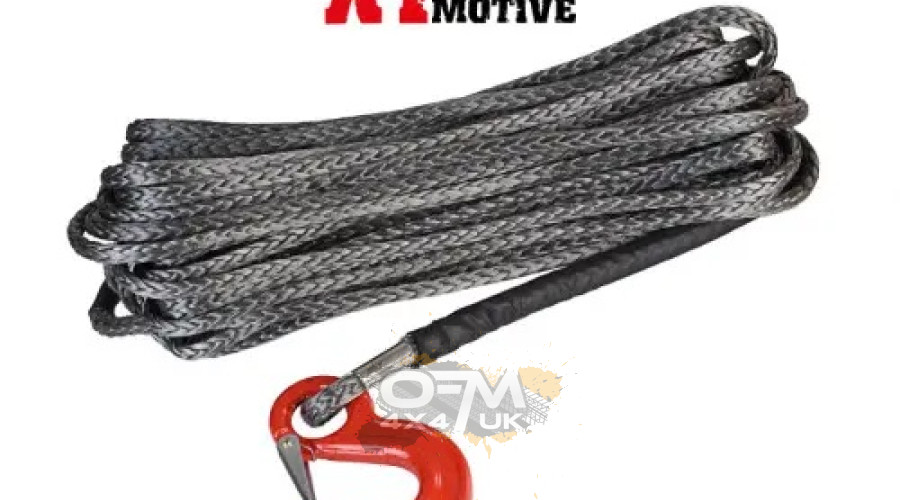
- XT Automotive Synthetic Winch Rope 10mm x 30m: listed with a thimble, hook and protective sleeve. Its extra length still needs checking against drum capacity.
- XT Automotive Steel Hawse Fairlead: listed for synthetic rope, with 10-inch mounting-hole centres. Check the exact winch and mounting arrangement before ordering.
The main image shows an XT Automotive rope assembly from the product listing. It illustrates the equipment, not an inspected customer rope or a diagnosis of wear.
Common questions
Does a fuzzy rope always need replacing?
Use the maker's inspection criteria. A slight initial surface fuzz and progressive loss of material are different conditions. If you cannot establish that the rope remains serviceable, replace it before the next recovery.
Can I tie a knot in a damaged winch rope?
Do not use an improvised knot as a repair. Any permitted splice or repair must follow the rope manufacturer's method and be carried out by someone competent to assess the result.
Can I choose a replacement by colour?
No. Colour identifies an option in a listing; it does not verify construction, load rating, length or compatibility. Confirm the full specification.
Need help checking a replacement? Contact OFM4x4 with the winch model, existing rope details and clear photographs of the mounting hardware. Resolve any missing specification before placing the order.
Further reference: WARN synthetic rope installation and operator's guide. Always use the current instructions for your own winch and rope.
Related Products


Leave a comment