


-32x32h.jpg)


-32x32h.jpg)

-32x32h.jpg)


-1000x1000h-32x32.jpg)


-32x32.png)


-32x32w.jpg)



-1000x1000w-150x150.jpg "DT Adventure Portable Camping 55L Compressor Car Fridge Freezer")
-1000x1000w-150x150.jpg "DT Adventure Portable Camping 55L Compressor Car Fridge Freezer")
-150x150h.jpeg "Fabryka 4x4 Front Steel Winch Bumper for Version With Plastic Wheel Arch Extensions Toyota Land Cruiser J90 99-02")
-150x150h.jpeg "Fabryka 4x4 Front Steel Winch Bumper for Version With Plastic Wheel Arch Extensions Toyota Land Cruiser J90 99-02")


Published 29 September 2026 · OFM4x4.CO.UK
Do You Need Extended Brake Hoses After a 4x4 Lift? Fitment and MOT Guide
A suspension lift can change how far a brake hose must reach as the axle and wheels move. A hose that looks comfortable with the vehicle parked may be pulled tight when a wheel drops into a rut or the steering reaches full lock. That makes hose length and routing part of the lift installation, rather than a check to leave until the next service.
The buying decision needs more detail than “2-inch lift”. Vehicle generation, ABS equipment, suspension travel, mounts and existing modifications all affect the correct kit. This guide explains what to check, what information to provide and how the MOT rules treat damaged or stretched hoses.
The quick answer
Use the hose specification required by your suspension kit and confirm clearance through the available steering and suspension movement. If the existing hoses cannot accommodate that movement without tension, twisting or contact, the installation needs correction before use. Do not assume every 50 mm lift needs the same extra hose length, or that a braided hose is automatically an extended hose.
In this guide
Why lift height alone is not enough
Nominal lift height describes a change in ride height. It does not, by itself, specify the greatest distance between a hose's mounting points. Longer-travel dampers, altered mounting brackets and other suspension changes can affect the movement the hose must accommodate. Two vehicles with the same advertised lift can therefore need different hose arrangements.
Use the lift manufacturer's instructions and the actual vehicle configuration. Do not simply add 50 mm to an old hose because the springs are labelled +50 mm. Equally, buying the longest available hose can create a loose loop that catches or rubs nearby parts. The aim is the correct length and routing throughout movement.
What the installer needs to check
Ask a competent installer to inspect the complete movement range using safe support and controlled suspension movement. The OFM4x4 hose listings specifically call for checks at full steering lock and full suspension droop. A parked-vehicle photograph cannot establish those clearances.
- At droop: the hose must not become taut or pull on its unions and brackets.
- At compression: check that the available slack cannot become trapped, kinked or caught.
- Through steering: inspect both directions, including the relevant combinations of steering and suspension movement.
- Along the route: check tyres, wheels, springs, dampers and other nearby components for contact, and retain the specified supports.
Record any bracket changes already fitted. Moving a bracket is not a universal substitute for an extended hose; use a relocation arrangement only where it is specified for the application.
Vehicle and ABS fitment examples
These examples show why the exact application matters. They are separate kits, not interchangeable options for any lifted Patrol.
| Listed application | OFM4x4 option | Check before ordering |
|---|---|---|
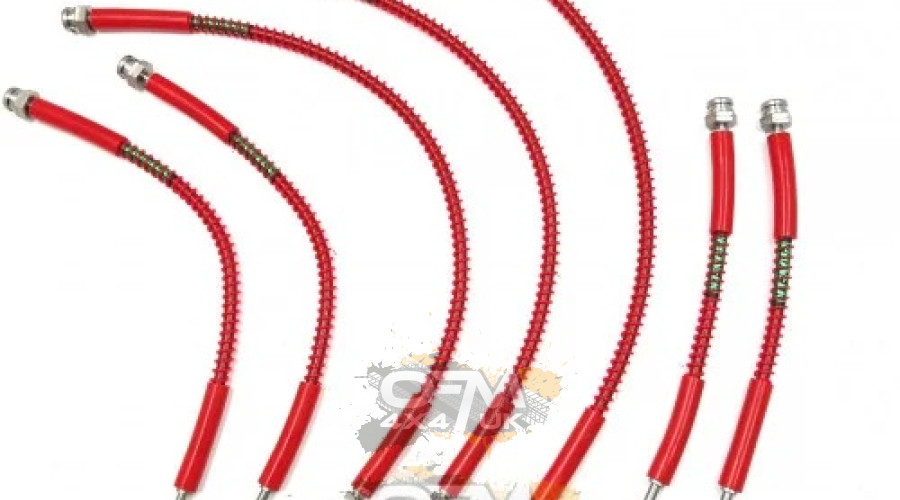
| Patrol Y61 GR/GU, 1997–2010, ABS | Y61 ABS seven-line braided kit | ABS application; seven flexible lines. Specify any required extension. |
| Patrol Y61 GR/GU, 1997–2000, non-ABS | Y61 non-ABS braided kit | Not the ABS kit. Confirm the vehicle's fitted system and hose configuration. |
| Patrol Y60 GR TD, 1992–1997, non-ABS | Y60 TD non-ABS braided kit | Confirm engine, year and non-ABS equipment; do not substitute a Y61 kit. |
These listings offer custom lengths for lifted applications. Contact us to confirm the required specification before ordering; selecting a vehicle name alone does not communicate the details of a modified suspension.
What to send before ordering
- Vehicle model, year, engine and VIN or chassis details where needed to identify the application.
- Whether ABS is fitted, confirmed from the vehicle rather than inferred from its badge.
- Spring and damper details, nominal lift and any changes to suspension travel.
- Details of relocated mounts, radius arms, drop brackets or previous brake conversions.
- Clear photographs of the current hose routes, fittings and retaining brackets, plus the supplier's requested measurements.
If a workshop supplies measurements, agree the reference points with the hose supplier. Overall assembly length and the exposed flexible section are not the same measurement. Ask which lines are included and which need additional length.
What the MOT manual says
The DVSA MOT inspection manual, section 1.1.12, covers flexible brake hoses for cars and passenger vehicles. Slight damage, chafing or twisting is classified as a minor defect; excessive damage, deterioration, chafing, twisting or stretching is major. A hose damaged enough to be likely to fail, or a hydraulic hose or connection leaking, is dangerous. Bulging under pressure is major.
These categories describe defects, not approval of a particular lift or hose kit. Do not describe an installation as “MOT approved” simply because the hose is braided, extended or advertised to a manufacturing standard. Check the finished installation and its condition.
Fitting and final checks
Have brake work carried out by a competent professional using the correct vehicle and hose instructions. Match the fittings and sealing arrangement, use the specified torques and brake fluid, bleed the system using the applicable procedure, and check for leaks. This article does not supply a universal torque or bleeding sequence.
Before returning the vehicle to use, complete the travel and steering checks and confirm correct brake operation. Arrange the instructed follow-up inspection. A hose upgrade is not a repair for another fault causing a soft pedal, pulling or poor braking.
For the wider suspension setup, see our adjustable panhard rod guide and Y61 sway bar link fitment guide.
Common questions
Does every 2-inch lift need extended hoses?
There is no universal answer for all 4x4s. Follow the kit requirements and inspect the actual movement and routing. If the specified kit requires extended hoses, include them in the installation.
Does braided mean longer?
No. Braided describes construction, while extended describes length. Confirm both the vehicle application and the ordered length. Hose construction alone does not establish clearance.
Can I choose the ABS kit because it includes more lines?
No. Choose the kit for the braking system fitted to your vehicle. More pieces do not make a different application compatible.
Can I keep driving if a hose becomes tight at full droop?
Have the installation corrected and inspected before use. Do not rely on avoiding rough ground to protect a hose that cannot accommodate the vehicle's available movement.
Need the correct hose specification? Contact OFM4x4 with your vehicle, ABS and suspension details. We can check the application and extension requirement before you order.
Related Products


Leave a comment